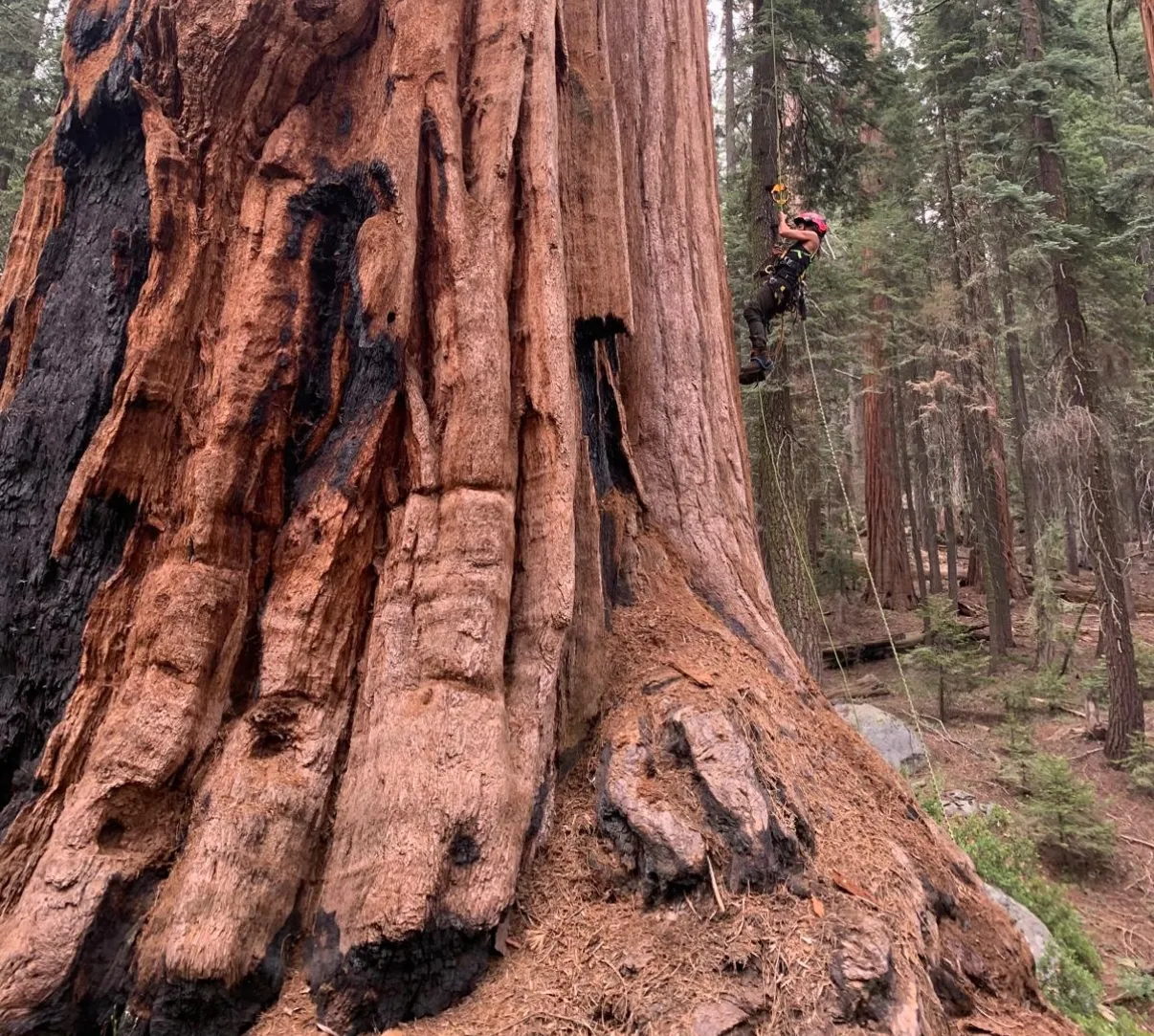
The first time I ever saw a giant sequoia was in July 2024, in Giant Forest, California — on a climbing trip with Ancient Forest Society to help canopy scientists understand how they are affected by fire and drought. By saw, I don’t mean in the casual sense of seeing a cat or a car. I mean the kind of dumb-stricken seeing that happens when the brain struggles to connect vision with comprehension.
I had climbed giant sequoias in the UK and casually strolled past them in arboretums, where they are often overshaded by another equally large conifer because they are infants in comparison. The oldest giant sequoia in the UK was planted in 1853 at Benmore Arboretum in Scotland. That makes our oldest recorded tree just over 170 years old.
Sequoiadendron giganteum is not weird, but it is wonderful. It is one of only two tree species in the entire world (the other being the coastal redwood Sequoia sempervirens) that can grow both over 90 metres tall and live for more than 2,000 years.
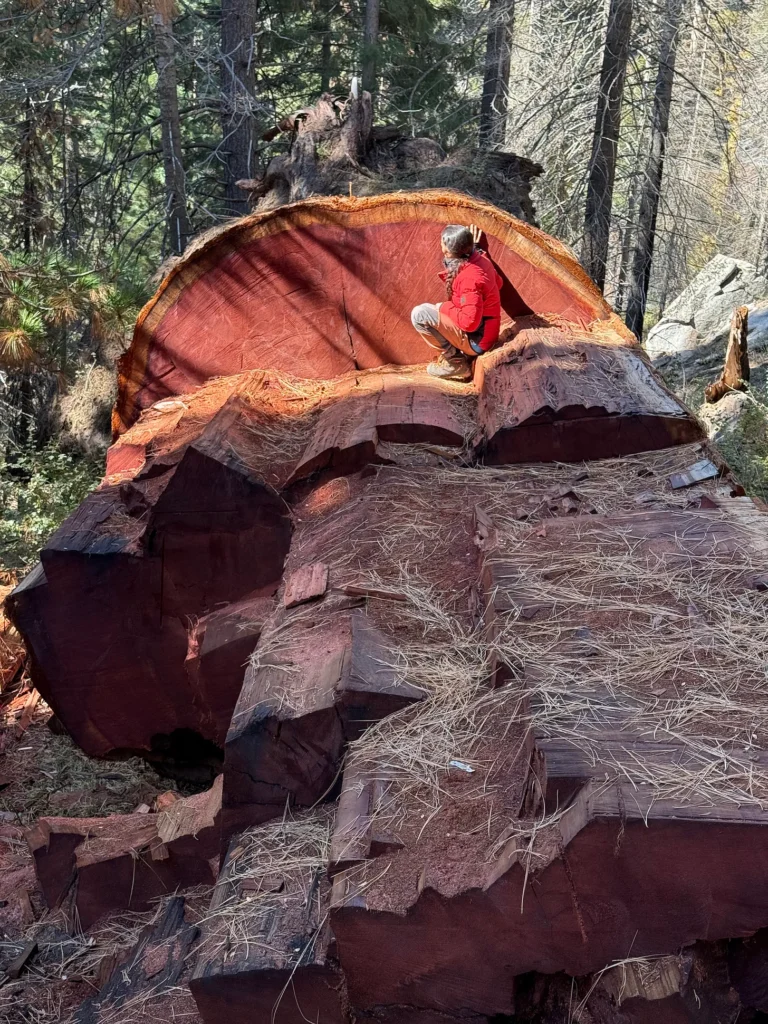
The giant sequoia is outrageously large tall and wide, bigger than anything I had ever encountered. You can literally drive a car, or even two cars side by side, through the base of a giant sequoia. People once did exactly that, thanks to a Victorian fascination with carving tunnels through living trees as a spectacle to lure tourists into the world of giants. They didn’t think far beyond the novelty, and two of those tunnel trees eventually fell: the Wawona Tree in Yosemite in 1969, and the Pioneer Cabin Tree in 2017. A lesson, hopefully, in what not to do.
Standing beside age that doesn’t look old
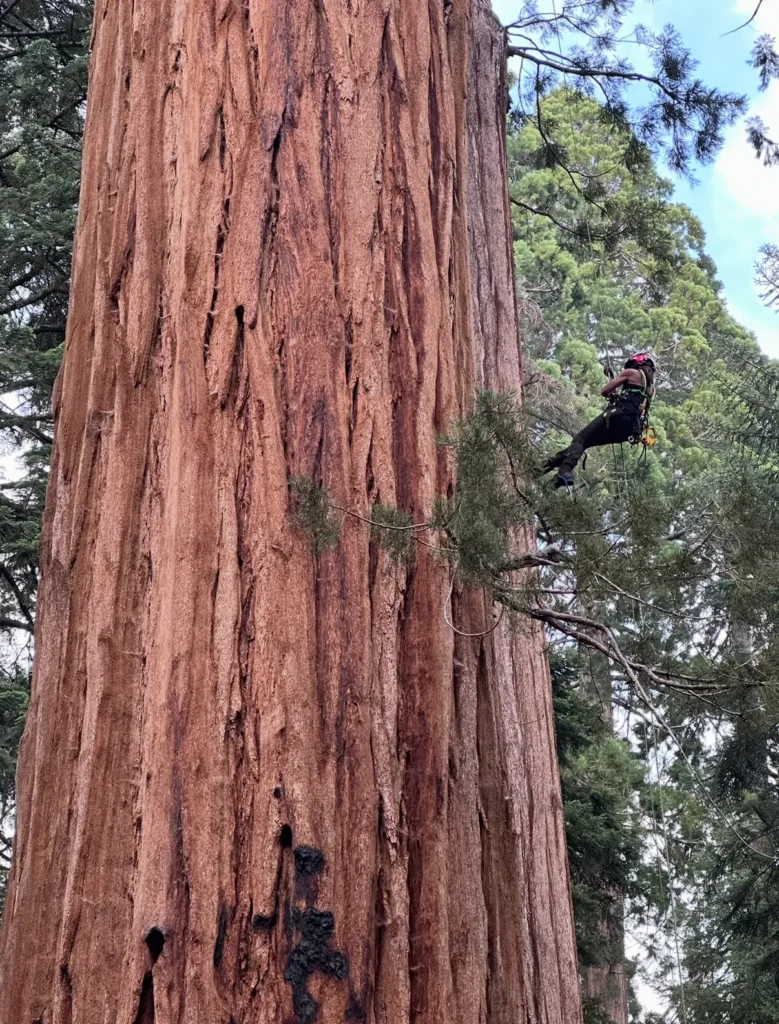
The first time I stood beside a truly old giant sequoia was also the first time I had climbed a tree over 300 feet tall. A tree called Gemini, a twin-stemmed goliath. You look up and there is just a massive, thick stem covered in orange-red, spongy bark that goes up and up without tapering at all, until your eyes finally meet the first branches 150 feet off the ground. And that’s it. That’s as far as you can see without leaving the ground.
At the base, putting my kit on and slowly rethinking my life choices, I was engulfed by the entrance to the innards of the tree, a vast cavity carved out by fire, revealing the intricate balance between fire and life that defines this species.
The trees that have survived in Giant Forest, a grove of about 1,880 acres, include many very old individuals, with several well-documented trees estimated to be over 2,000 years old and a handful approaching 3,000.
I’m reticent to use the word ancient, because I’m not sure that (a) that word fits, and (b) it might involve rewriting the entire textbook about what ancient trees are. But hashing ideas out is the spirit of this article, so here goes.
Standing beside a tree like that, it becomes hard to know what we even mean when we say a tree. Not in the poetic sense, but in a biological one.
Ancient is not a measure of time
There is no single biological age at which something becomes ancient, it also depends on the species and the context. A 300-year-old bristlecone pine living at altitude in the High Sierras might be a juvenile. A 300-year-old oak tree in the UK is mature.
Trees age chronologically in years, but biologically they do not age as unified organisms. In arboriculture, an ancient tree is rarely a single, coherent form anymore. By the time a tree reaches what we describe as an ancient phase of life, it has often become a collection of semi-autonomous living units — different parts of the tree operating at different stages of growth, decline, and renewal.
An ancient tree doesn’t stay alive by keeping all its parts alive. It stays alive by continually replacing parts, while the overall structure remains.
A very old tree can have very young epicormic growth (water shoots) in its crown alongside much older tissue. Parts fail when their physical structures can no longer adapt to the environment around them, while other parts persist, or begin again. So, there is this interesting Benjamin Button effect in trees where old trees can be both very old and very young. That’s different to how we age as humans — in one direction only, a bit wrinkly and a bit southerly. Trees age chronologically in years, but biologically they can age sideways, and sometimes backwards.
This raises an uncomfortable question when we look at giant sequoias.
Are the oldest giant sequoias alive today actually ancient, or are they simply very old? Just for context, the oldest recorded standing giant sequoias are estimated to be around 3000 years old. But we actually don’t know what their upper age limit is because humans, disease or the environment seem to get them before we actually know.
And if a giant sequoia does eventually enter an ancient phase, does it even remain a single tree anymore? Or does it, like other long-lived species, persist as a kind of living colony — younger units growing on the bones of something way older?
Trees do not all age in the same way
Trees don’t age in isolation. They age within ecological niches.
Giant sequoias evolved as forest trees, growing in groves surrounded by other giant sequoias. Their architecture and physiology are shaped by competition for light, by buffering from wind, and by disturbance regimes dominated by fire rather than grazing. In this context, its habit of growing very tall and very wide (gigantism) for as long as possible makes sense. (Hydraulics start to becoming the limiting factor over about 300ft, because water and gravity are hard components to mix).
The English oak (technically the common oak of much of Europe), by contrast, evolved largely in open or semi-open landscapes shaped by grazing, browsing, and abundant light. It did not need to grow excessively tall. Instead, its survival strategies favour broad, spreading crowns, tolerance of exposure, retrenchment (canopy growing lower down), and the ability to persist while hollowing out and fragmenting structurally.
Age expresses itself differently depending on a species ecological niche.
What we recognise as ancient is often a visual language of decline.
An old oak becomes smaller and fatter to survive time. A giant sequoia may remain tall and productive for thousands of years.
Both may be old, but they are playing different evolutionary games.
Oaks survive by changing their architecture. Sequoias survive by maintaining it.
Yielding form vs continuity
An ancient oak often looks ancient because its strategy involves yielding form — trading height and dominance for persistence. A giant sequoias strategy is continuity: becoming so large and tall that most threats simply stop mattering.
This leaves me wondering what a truly ancient giant sequoia would look like. Not three thousand years old, but ten thousand. Open-grown. Shaped by fire, wind, storms, and mechanical failure, without the shelter of a surrounding grove.
Would we even recognise it as a single tree at all?
I’ve climbed a number of very old sequoias now. The tops are often dead, replaced by newer growth. The tree is reorganising itself — growing younger crowns on older foundations.
Old coastal redwoods and giant sequoias do not slow down simply because they are old.
As long as they continue to increase in size and maintain healthy crowns, they: add more (absolute) wood each year, not less, continue increasing biomass, respond strongly to changes in their environment. Their adaptive capacity is remarkable, and there is little evidence of true senescence — decline driven purely by age.
Giant sequoias are not speeding up in the way young saplings do. Their leaves are not working harder. Their cells are not becoming magically more efficient. They produce more wood simply because they are massive.
In very large trees, a thin growth ring wrapped around an enormous circumference can represent a greater volume of new wood than a wide ring on a small trunk. Studies that involve mapping the crown for incremental growth rather than ring width alone show that many large, old trees continue to increase their total annual wood production for centuries.
So, what eventually kills them?
It does not appear to be age itself, but external forces: fire that burns hot enough to reach the crown, pathogens entering through wounds, bark beetles, drought beyond physiological tolerance. Age increases the chance of damage, simply because the tree has been around longer, but it does not directly reduce the trees capacity to grow.
Which leads to a final question.
It may well be that trees belonging to different architectural model groups, age in fundamentally different ways. The English Oak and the giant sequoia would be in two different categories. That’s the most straightforward explanation. But do we actually know this to be true? We know about the giant sequoia because it has been studied, and its crown has been studied. Which opens a wider, more interesting question: are giant sequoias genuinely exceptional, or are they simply better studied? Have we misunderstood how very old trees grow because we’ve been measuring the wrong things, in the wrong places, and with assumptions already built in? Ring widths taken at breast height tell only a small part of the story, particularly in trees with complex crowns and enormous, vertically distributed biomass. If we climbed more species, if we measured entire trees rather than relying on trunk size alone, and if we let go of the assumption that growth must inevitably decline with age, might we discover that many trees continue to grow vigorously into old age, much like sequoias appear to do?
Tags: