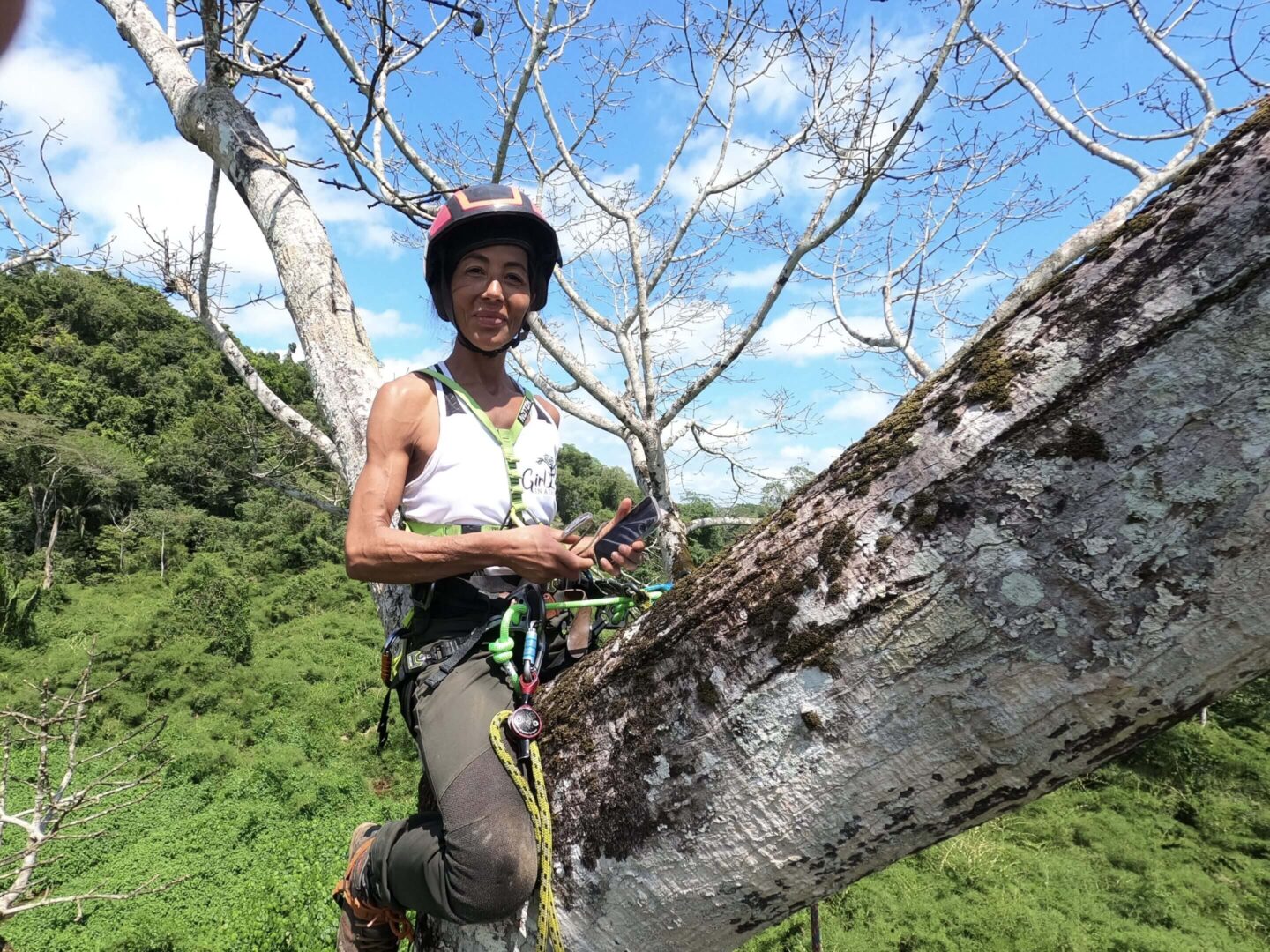
The ceiba tree is one of those trees that takes your breath away when you’re standing folded into its buttressy roots. It’s a truly special tree, and the video above is of one in Belize I always try to return to, because it has that kind of effect on you. It invites you in. It’s a tree considered sacred by the Maya, and one that I come back to later in this essay.
Sadly though, that kind of relationship with trees isn’t something I see very often in the UK. As someone who works on, and loves trees, I spend a lot of time around people who don’t.
To an arborist, a tree can be extremely awkward to climb — congested crowns with their criss-crossing branches, or completely open spaces with nothing to stand on; branches and epicormic growth (young regrowth) going rogue, up noses, in ears, tying you in knots and trapping you in place. I once climbed a huge Monterey cypress with a pigeon infestation so bad, my climbing rope might as well have been soaked in Vaseline for six months. Nature occasionally feels as though it’s been designed by a four-year-old — wildly inventive, not very logical, but somehow very real. In trees, the impossible becomes possible, and that has been my lesson as someone who works with them.
To a client, it’s often something else — a ‘thing’ that blocks light, drops leaves on the car, and competes for space where they’d rather have a garden room.
I understand those frustrations, but it leaves me with a question I keep coming back to:
How do you connect people to trees when they see them as objects — or problems to be solved?
I ask it because there is a ripple effect, and consequences to that answer, and I see it on a daily basis. Even on my short drive through the green lanes of Surrey, there is evidence all around: healthy trees being removed, again and again.
When Knowledge May Not Be Enough
We now live in a world where we know more than ever before about trees, but interestingly, that knowledge doesn’t seem to protect them very well.
It wasn’t that long ago that sacredness offered protection.
Trees were once considered gifts, and in many cultures considered a bit like a non-human granny — kin, and part of everyday life. There was a natural order of give and take between people and land. Sometimes there was reverence, sometimes fear. But either way, they were protected — not just because they were useful, but because they meant something.
I don’t want to romanticise indigenous land management — these things are never simple — but it’s really interesting to see the pattern. The UN/IPBES 2019 Global Assessment, one of the most comprehensive biodiversity reports ever produced, found that nature is declining everywhere, but declining less rapidly on lands managed by Indigenous peoples. There’s no simple cause-and-effect conclusion I’m afraid — it’s a complex mix of history, land governance, and circumstance — but it’s based on the work of around 150 scientists and over 15,000 studies, and there may be something really interesting in there for how we relate to our natural world.
The Stories That Changed Me Growing Up
I was reminded of this on a trip last year to Belize to install some acoustic sensors in the canopy of trees.
We were on horseback, trying to find a tree only accessible by trail. Before we entered the forest, our guide — big, burly, fully saddled in western gear — paused quietly and whispered something into the trees.
I asked him later what he was saying. He said:
“That was for duende. You have to ask permission before you enter.”
Tata Duende is a story with Mayan origins told across Belize, passed down through generations. It’s where my mum is from, and where I spent a lot of my youth and adult life. It’s told to every child old enough to listen, and it was of course told to me as a child. Like any good oral story, it shifts a little, morphs slightly with each telling, and depends on what the listener hears. But my interpretation was it seems to have a purpose: to protect.
 Tata Duende — the mischievous hobgoblin from Belizean culture.
It’s a story about a small, grey-bearded forest spirit with backwards-facing feet, no thumbs, known for leading people astray if they disrespect the forest. A mischievous little hobgoblin, but with big consequences. Said to appear at night, braiding the manes of horses into tight plaits so he can ride them.
It’s not quite Blair Witch Project, but it’s also the kind of story that stays with you.
Like any Hansel-and-Gretel-type fable, it’s easy to dismiss as folklore, but the interesting thing is it’s told to all children at an age when the brain is a bit more malleable. I was told many stories as a child, but the only two that stick in my mind are Tata duende, and Star Wars, because I liked Yoda. So, story telling in many cultures, does something real, and children grow into adults with those words woven through their bones. These stories may not explain the deep intricacies of forest ecology, but they create a boundary, and a sense that you should pay attention, tread carefully, respect what you’re moving through, and don’t run off into a tropical forest!
Meaning Changes Behaviour
Even as a child, I understood this. There was an old beech tree at my school where abscission wounds (the marks left where branches had fallen) had formed eye-like scars in the bark. I had years of being arboreally taunted by those fictitious evil eyes, and I stayed well away from that tree for the entirety of my school life.
But thankfully not all protection comes from fear. Some comes from awe.
The Tree That Connects Worlds
I have climbed the ceiba tree (Ceiba pentandra) in Belize — more commonly known as the kapok tree, whose fibres were once used to stuff pillows and teddy bears. For the Maya, it was a tree that connected worlds — the underworld (roots), the earth (the trunk was the human realm), and the heavens (held up by branches).
The ceiba is one of those rare tropical trees that has a period of dormancy — I thought it was dead when I first saw one, and had to rapidly recalibrate my ecology and geography to understand why a dead tree could feel so alive. From December to April, its buds are closed tight when everything around it is lush and green. There is one particular ceiba tree within the land of a resort called Jade Jungle in the Cayo district (it’s in the video above).


The land was once used by the ancient Maya as a ceremonial and residential site centred around a plaza. It later reverted to secondary rainforest and now forms part of a protected buffer for the Tapir Mountain Nature Reserve. On this land, a few hundred metres from the ceremonial site, stands this iconic tree, its full buttressed roots allowing it stability in shallow, nutrient-poor soil. The difference between it and the low-level vegetation, with its entire dictionary of greens, is stark. There is this grey-white giant, virtually asleep in its crown, set against the lush green of understory shrubs like heliconia and gingers, grasses, and palms below. And despite sharing the same ecosystem, they feel separated by time (the ceiba perhaps 200 years old), making the tree and everything around it feel like worlds apart.
In the dry season, the sun is relentless. Thin-barked trees like beech can often suffer sunburn, and although the ceiba tree’s bark isn’t quite as smooth, it fares exceptionally well in the extreme heat of the tropics.
The odd epiphyte sat in crannies on branches, but essentially it was a wide, open vase of branches and space, and its openness seemed to be the thing that draws you in. A hundred feet up, you get the sense that the crown sits in its own stratosphere, with nothing matching its height other than a guanacaste tree covered in vines nearby. That height differential between it, and the surrounding ecosystem means more exposure to the elements, and even more incredulous that it’s still standing despite two dozen major hurricanes in Belize over the past century or so.
The ceiba can get tall, big, and old for a jungle tree, and will often out survive many of the trees that once grew before it — a kind of quadruple whammy for creating awe. You can see why the Maya revered it.
Science, Mystery, and What Remains
Forests here weren’t selectively spared — they were cleared. Valuable trees like mahogany were taken first, with extraction peaking in the 1920s and 1930s. The logs were dragged out through the forest and, when the rains came, floated down rivers like the Belize or the Sibun river, and eventually exported to Britain, and the USA. There are few (if any) mature mahogany trees left now in Belize. In their place are remnants — rotting stumps in the forest, or timber now in the form of tabletops and other colourful furniture featuring the stripes of other tropical woods.


In the process of meeting that demand, many other trees went with them — trees that were awkward, less useful, or simply got in the way.
And yet, this ceiba tree remained. And actually, many other mature ceiba trees in Belize have too.
I don’t know whether that comes down to cultural meaning, practical circumstance, or some combination of the two. But it does make you wonder whether meaning has a role to play in what gets left standing.
I don’t have a clear answer. But when you look at the distribution of ancient trees, there are patterns there too. In the UK, we are losing them faster than we can replace them. Yews were once simply places where people gathered, long before churches, and now many of our oldest yews are found in churchyards, places where (for now at least), they’ve been protected. Our oldest oak trees for example are often found on private land, places that haven’t been cleared to make way for a supermarket or a car park.
So where trees survive is rarely random. There are clues in who owned the land, and how that land was used over time.
But what I do know is this: trees no longer seem to matter in the way they once did. There is a growing disconnection between people and nature, and for the most part they are seen as objects, resources, or problems.
I think there are two ways we come to see trees differently. One is early in age through stories, before the societal conditioning of education, money, marriage, job and retirement sets in. The other comes later, and often less gently when something in life breaks open and it forces the magnifying glass to come out and look at how we’ve built our lives — but I’m not sure knowledge alone ever does it.
I really started to see trees for the first time in my later thirties when I was on the ragged edge of a life without much meaning. It’s a shame it came to that extreme, but the natural world pulled me back into something when I had drifted dangerously close to the edge of not wanting to be here at all. At some point in that process, they became my teachers, and they’re really good at it!
We can’t return to the past — that ship has sailed. There are 8 billion of us now, living in very different systems and times, but I do think there’s something we can learn. Not about trees, exactly, but maybe about how we relate to them.
I used to think knowledge was enough, but I don’t know if that’s true anymore.
So, I’ll leave you with this, and I’d love to know what your answer is:
What would make trees really matter again?