
I absolutely love figs. I suspect it’s a relic of my parents’ slightly chaotic fig tree, and the ritual of being offered one with a cup of tea to make all bad things good again. In our house, when a day had gone sour and a bit pear-shaped, you ate a fig and drank a cup of PG Tips — and somehow the world righted itself.
But beyond their slightly mystical ability to lift the human spirit, figs are also an extremely interesting tree.
Every time I talk about them, the word fruit wants to roll off my tongue — with the small caveat that figs aren’t, strictly speaking, a fruit at all. Or at least, not a single one. I came across this in a lovely book called Gods, Wasps and Stranglers by Mike Shanahan and it really changed how I see them.
What we call a fig is actually a structure known as a syconium: a hollow, fleshy chamber lined on the inside with hundreds of tiny flowers, all facing inward, hidden from view.
What happens next depends on where you are in the world. In tropical forests, those flowers are pollinated by tiny fig wasps, and each tiny flower can develop into its own tiny fruit, complete with seeds, all contained within the fig. In places like the UK, figs often develop without fertilisation — but the structure itself remains exactly the same.
So what we experience as a single fig is not one fruit at all, but a collection of many.
It’s one of those enigmas of language that can get pretty pedantic depending on how far down the taxonomy rabbit hole you go—but every now and then, it’s fun to see where it leads. We get used to calling something what it isn’t. Strictly speaking, a fruit develops from the fertilised ovary of a flower. But our need to categorise nature often creates its own confusions, and many of the fruits we think we understand are, in fact, botanical illusions. Strawberries carry their fruits on the outside, apples are ‘pomes’ and mostly flower tissue (receptacle), and a banana fits the botanical definition of a berry!
Figs, meanwhile, take it a step further — hiding their flowers entirely inside what we casually call the fruit.
And figs are full of these contradictions.
The figs we grow in Britain (Ficus carica) share this same strange “fruit” structure with their tropical relatives — but after that, things begin to diverge pretty quickly.

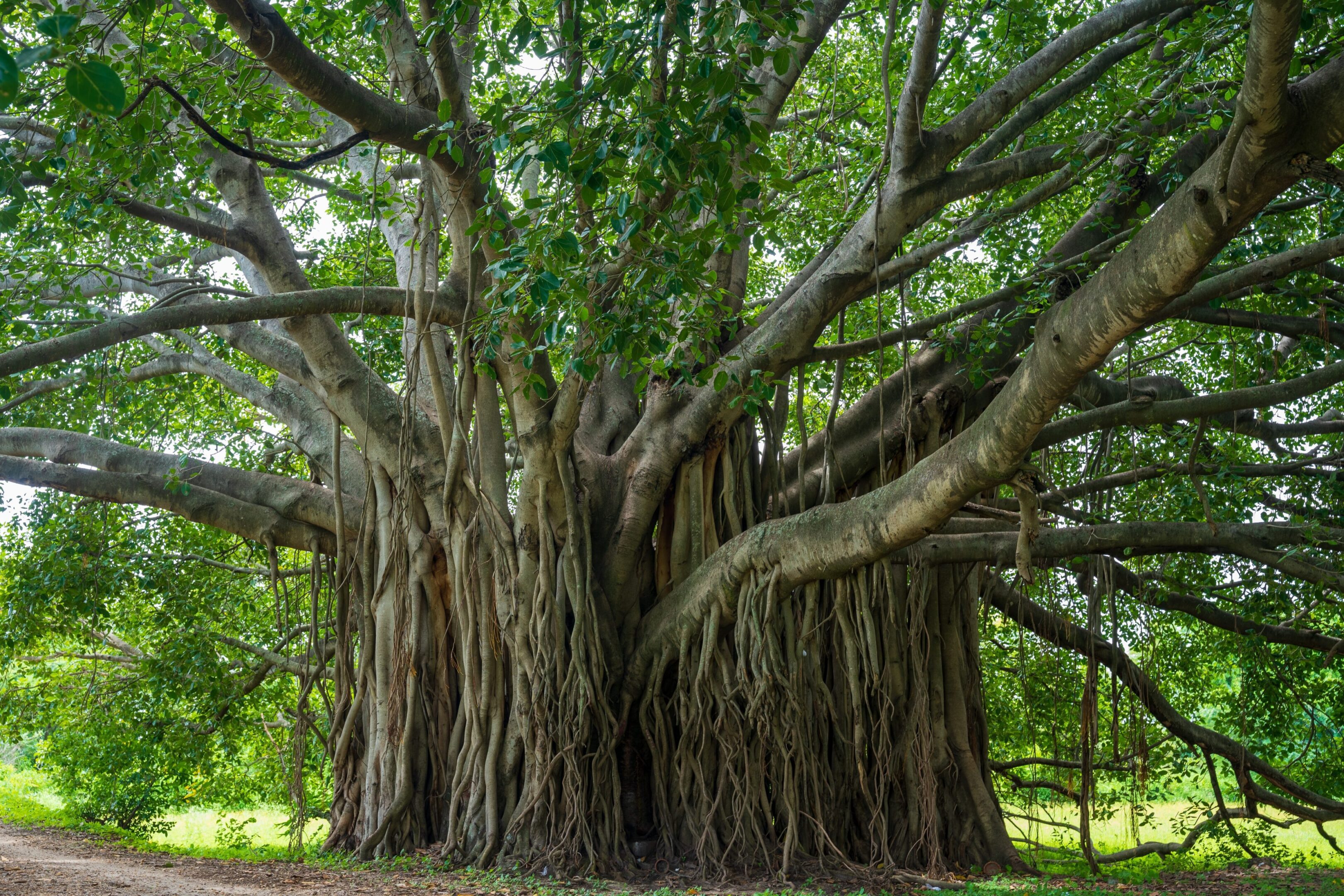
In tropical forests, many figs take on a more dramatic form: the strangler fig. There are hundreds of species that follow this growth strategy —one of the most iconic being the banyan (Ficus benghalensis pictured above), known for its otherworldly architecture, and curtains of roots descending like wooden stalactites.
There are around 800 species in the Ficus genus, with around 350–500 species known to use this ‘strangling’ strategy. They are found in the tropics — across South and Central America, Africa, Asia, and into Australia — wherever warmth, moisture, and dense forests allow them to establish high in the canopy.
And that’s exactly how it all begins.
A seed, dropped by a bird, lodges in a crevice or branch union of a host tree and starts to germinate. Perched high above the ground, the baby fig lives first as an epiphyte. From there, aerial roots descend toward the forest floor, gradually thickening and wrapping around the host — a snake-like lattice that tightens over time, sometimes outliving the tree that first held it.
When I first saw this process in Belize, it felt — and still feels — pretty violent. It’s like watching a slow strangulation into death. But this is where the story becomes truly fascinating, and where I found myself leaning on the book: Gods, Wasps and Stranglers.


Leaning on Gods, Wasps and Stranglers
Writing about trees is difficult — really difficult.
You are trying to dispel the illusion that a tree is simply a tree, when on the surface it looks exactly like that: a solitary object, not doing an awful lot.
Understanding helps us build a relationship with them, kind of like a good friend. The more time we spend with them, the more that relationship deepens. But facts alone can feel dry, a little brittle and they don’t often stand the test of time. Scientific knowledge shifts as we discover more — as it should — but facts alone rarely move people. When people stop caring, the living world begins to disappear, as history has shown us.
Storytelling does something different.
It tethers science with something more human, weaving fact into story so it stays with us — and helps us see the living world differently so we can learn to be part of nature and each other, rather than separate from it.
Gods, Wasps and Stranglers does this really beautifully. It takes a set of biological relationships that might otherwise remain buried in the underworld of dense scientific literature, too complex to bring to light, and turns them into a story about how forests really work. When I read a nature book, I’m not only looking for facts, I also want curiosity and story. I want to close the final page feeling that I’m a bit different. That I can look at the natural world through eyes and a brain that work better than they did before.
And that’s why I want to share it.
Strangler figs are keystone species, meaning entire ecosystems depend on them. Their fruit feeds birds, bats, monkeys and even tree kangaroos (I didn’t know this even existed before reading this book) when other food is scarce. Remove figs from a tropical forest and the entire web of life starts to unravel.

And yet the fig itself survives only through an even more extraordinary partnership.
Each species of fig relies on its own tiny pollinating wasp (from the family Agaonidae) to pollinate the flowers hidden inside the syconium. These relationships between fig and wasp are highly specific — essentially one species of fig wasp pollinates one species of fig tree. Without that insect, the tree can’t reproduce. Tree and wasp have evolved together over tens of millions of years, their lives intertwined in a relationship so precise you can’t help wondering “how on earth can that happen?” We see something similar with the Joshua tree — technically a yucca — whose survival is bound just as tightly to its pollinator, the yucca moth.
The figs growing in British gardens follow a different path. Most ripen without pollination at all. The figs we eat in the UK swell and mature through the action of plant hormones, even when the flowers inside remain unfertilised — a botanical workaround known as parthenocarpy.
Seen this way, a fig tree is not simply a tree.
It is a network of relationships — birds, insects, mammals, fungi and time — all balanced on a very delicate and precarious edge of cooperation.
Climbing among stranglers
I have climbed strangler figs in the rainforests of Belize. This was to remove some acoustic sensors ripped apart by hurricane winds — interestingly the trees fared better than the sensors. These are terrains where the impossible somehow becomes possible and everything feels like it’s trying to kill you: the heat, bees, snakes, ants — even orchids, bryophytes and pockets of canopy soil begin to look a bit sinister. I looked like Quasimodo by the time I came down from that tree. But what you see very clearly from up there is how the strangler’s life begins in dependence on another species. It’s like starting life with a well-stocked fridge.


One of the things I hadn’t fully appreciated before reading the book is just how important figs are ecologically.
Across tropical forests strangler figs fruit multiple times a year, feeding an astonishing diversity of animals when other food sources are scarce. Birds, bats, monkeys and countless other creatures depend on them.
Let’s return for a moment to the fig wasp — the tiny insect that makes all of this possible. The female wasp enters the fig through a narrow opening, often losing her wings and antennae in the process. Once inside, she pollinates the flowers and lays her eggs… and that’s the end of her life cycle. The fig produces enzymes that break her body down completely. By the time the fig is ripe, there’s no wasp left in any recognisable form. Just nutrients, absorbed back into the fig itself.
She never leaves the fig, and literally becomes part of the very thing her offspring will then leave behind when they emerge — carrying pollen from that fig to the next.
It’s an example of total interdependence — and a complete cycling of life. The fig wasp dies inside the fig, but she also becomes part of the system that continues it.
The survival of one species is tied almost completely to the existence of the other.Remove the wasp, and the tree can’t reproduce. Remove the tree, and the wasp has nowhere to live.

Life, death, and systems
Strangler figs are sometimes described as parasitic, but technically they are not. It’s not too dissimilar to Ivy, where it will use another tree for structural support rather than extracting nutrients from it. What makes them dramatic is the architecture of their aerial roots, which eventually surrounds the host tree in a cage of living wood. Seen up close it can look pretty destructive, but zooming out through a wider ecological lens it becomes something else entirely.
In forests, life and death rarely belong to individuals alone — they belong to systems. One organism creates opportunity for another. Structure becomes habitat. Decay becomes opportunity for life.
The strangler fig begins life on a host tree, yet can ultimately outcompete it—going on to sustain an extraordinary web of relationships: birds, insects, mammals, fungi—all waxing and waning through time.
Why this book matters
What I loved most about Gods, Wasps and Stranglers is the way it animates the science. The biology is rigorous, but there is a good dose of cultural history and myth thrown in, so it never feels cold or detached. Instead, it reveals the beauty of life and death unfolding together in natural systems.
The ecological relationships described in the book feel incredibly tight — species evolving alongside one another, dependent on each other in ways that seem almost impossibly fragile. And yet these partnerships have endured for millions of years.

Final thought
After reading the book, it becomes difficult to see a fig tree as just another tree. In parts of the UK now, the fig wasp (Blastophaga psenes) has begun to appear as our climate warms. Could this be ancient partnership re-emerging?
And it makes you wonder.
A fig is not simply a ‘fruiting’ tree but a hidden architecture of flowers, insects and animals — sustaining entire worlds that most of us rarely notice.
Once you know that, it becomes difficult to look at a fig in quite the same way again.
And I might just never call it a fruit again!
Tags: Ficus microcarpa, Ficus species, aerial roots fig tree, banyan tree ecology, canopy ecology, crown structure trees, epiphyte relationships, fig tree ecology, fig tree life cycle, fig tree pollination, keystone tree species, plant–pollinator mutualism, strangler fig ecology, syconium structure, tree architecture, tree reproduction biology, tree–insect relationships, tropical forest ecology, tropical tree canopies, urban fig trees