The Tallest Trees in the World — and the Paradox of Scaling Up
My fascination with very large things probably started before I could even talk — mountains, tall pine trees, roaring rivers, cavernous caves. My love of the outdoors has always been deeply ingrained, and with it a quiet sense that we are a very small part of a much greater system. The simplest explanation might be that large things create perspective.
The tallest living tree currently known on Earth — a coast redwood named Hyperion — stands at 116.07 metres (measured in 2019 by canopy researcher Steve Sillett).
There are other contenders, like the towering eucalyptus of Australia (Eucalyptus regnans), but this is where things become less straightforward: the problem of measurement.
Reaching the record books depends not just on height, but on how — and whether — a tree can be measured at all. That means access, permission to climb, the ability to do so, and then taking a precise measurement, ideally confirmed with tools like LiDAR (which has its own set of limitations)!
The most accurate method is still to climb to the top and drop a tape — and that in itself can be extremely challenging. But this isn’t really a piece about the absolute tallest tree (that will inevitably shift), but about how trees live and grow at the edge of what’s possible.
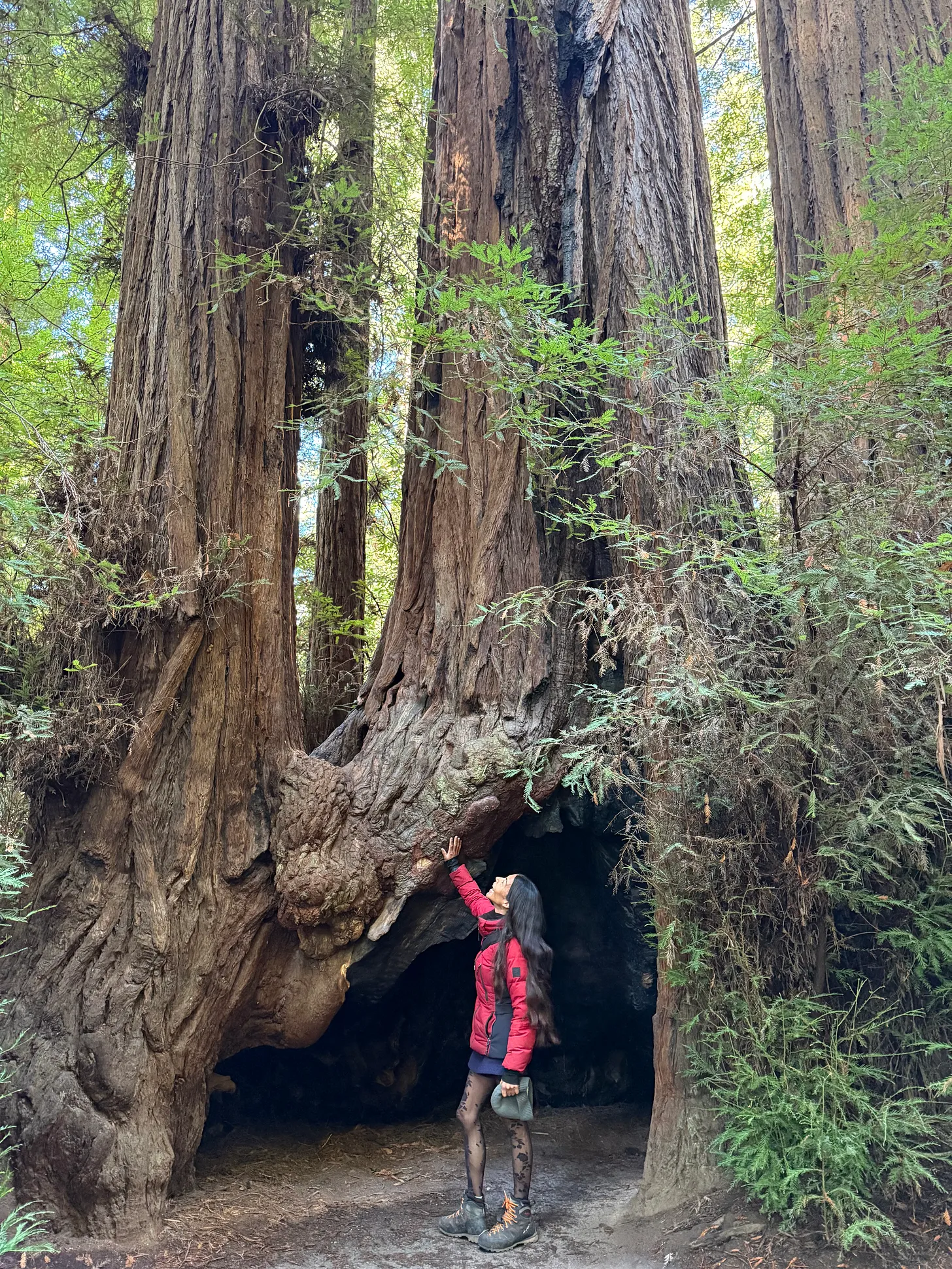
 Not Hyperion (which has an undisclosed location to protect it) but an old-growth coastal redwood in Henry Cowell State Park, California.
Several decades later, climbing giant sequoias with scientists like Anthony and Wendy with Ancient Forest Society AFS offers that perspective but in a far more profound way. Sitting high in their crowns makes me feel incredibly small, very young, and embarrassingly aware that we probably have very little understanding of what intelligence actually is. Trees respond to their environment with a precision we rarely achieve ourselves. They don’t try to grow — and yet they do, extraordinarily well.
My reverence for trees isn’t reserved for the oldest, tallest or any other superlative we like to assign them. A young rowan is no less remarkable to me than a 4,000-year-old yew. And yet spending time among very large trees does something peculiar — they seem to reorganise me from the inside out, putting the little fragmentations back in place. A bit like balm for the soul.
I think part of it is their scale. These trees exist at sizes that should push hard against the physical and biological constraints that govern everything around them.
And that is where this journey of paradoxes (in the impossible space of an essay) begins: the biggest, tallest and oldest redwoods often seem to get better at being alive as they age.
A small warning before we continue! This essay becomes a little more knowledge-heavy from here, so I’ve added subsections to ease the reading. But understanding the constraints trees work within helps reveal just how astonishing their solutions really are.
Scaling Up
The problem of scaling up should be a very real one. Humans struggle with it constantly in our own architecture. As structures grow taller, the forces acting on them become harder to manage.
Gravity technically weakens with altitude, but over the first 100m, from sea level to the crown of a tall redwood, the difference is negligible and irrelevant to tree biomechanics. What certainly does change is the difficulty of resisting its effects. And yet the tallest trees on earth do exactly that.
Big vs Tall — Two Different Solutions
Giant sequoias are the largest single-stemmed trees on Earth by volume. General Sherman, the most famous of them, has a trunk that alone weighs roughly 1,400 tonnes. (General Sherman Tree data published by the U.S. National Park Service
But they are not the tallest.
There are larger living organisms in total mass — such as Pando, a clonal colony of quaking aspens in Utah — but these consist of many stems sharing a single root system rather than one giant trunk.
When we think of the ‘tallest,’ that belongs to their close relatives: the coast redwoods like Hyperion.
These trees belong to a lineage often loosely referred to simply as the redwoods — which is where some confusion begins. In fact, three living species belong to this group: the giant sequoia (Sequoiadendron giganteum), the iconic fat-trunked trees the Victorians famously carved tunnels through; the coast redwood (Sequoia sempervirens), unrivalled for height; and the dawn redwood (Metasequoia glyptostroboides), a species once known only from fossils before being rediscovered alive in China in the 1940s.
The Three Redwoods

They are closely related but belong to different genera and occupy different ecological niches — three separate evolutionary pathways that, under the right conditions, have allowed these trees to become extraordinarily large.
Gigantism itself (assigned as an architectural strategy for coastals and giants) was not so much an evolutionary objective. Rather, it likely emerged as a consequence of traits that proved to work really well in particular environments, and were passed on. Growing tall provides a clear benefit in dense forests where access to light is limited, but the advantages of enormous trunk diameter are not so obvious. Speculation is always fun though, and possibilities include fire resistance, structural stability and resilience to damage over time.
In other words, closely related trees have solved the challenge of scale in different ways — some through height, others through mass.
The Structural Paradox
As organisms grow, they begin to run into the simple mathematics of scale — the square–cube relationship. Mass increases faster than the structures that support it, and structural problems compound as trees get larger. The bigger a tree gets, the harder it becomes to move water, the more stress its structure experiences, the more complex its vibration patterns become in strong winds, and the more energy it needs to maintain its massive biological systems
If large trees were simply small trees scaled up, they would essentially vibrate apart or shear in the 70-mph pacific windstorms that sweep through many redwood forests.
Instead, they solve these structural problems through their architecture: flexible wood, enormous trunks, the ability to rebuild new crowns lower down when tops fail, interlocking shallow root systems, crowns that dissipate wind energy — and the ability to bide time.
Young redwoods seem to understand something I wish I had known when I was younger — they spend decades investing in their foundations before committing to height. The firmer your foundations, the more storms you can weather. It’s not a bad analogy for a good life.
Canopy researcher Steve Sillett calls this structural capital. Not psychological capital, social capital or cultural capital — trees simply accumulate the right capital in the right order. Humans often try to do the opposite.
The Hydraulic Paradox
But even if a tree can remain standing, we circle back to the question that presses itself into you when you’re sitting high in one of these trees.
Last October I was sitting in a grand and very beautiful giant sequoia — named rather aptly ‘Mephistopheles’ — waiting for the sun to rise. There was a Stellar’s Jay perched near me, looking pretty unamazed by the whole thing.
But attention sharpens in places like this. And the strikingly obvious question is this:
 Dead tops and extremely large branches 250ft up on a giant sequoia, with Brian one of the volunteers with AFS.
 How on earth do you get water up something this tall and big?
Right at that moment, water was being pulled upward through specialised xylem cells called tracheids, travelling through the tree only millimetres from where my limbs and body were perched. These are different from the xylem vessels found in many deciduous trees — narrower in diameter, more conservative in design, but far safer under tension.
Hundreds of feet below, the roots were drawing water from the soil. Above me stretched an enormous complex crown of wood, branches and leaves, all of it dependent on water moving from soil to tips.
The entire system is driven by evaporation from the leaves.
As water escapes into the atmosphere through microscopic pores called stomata, it creates a tension that pulls a continuous column of water upward through the tree — from soil, into the roots, through the trunk and branches, and finally out of each leaf. So water rises under tension, being pulled upwards.
Which brings us to another paradox: the taller the tree grows, the harder it becomes to pull water to its crown.
The Physics of Height
For every metre a tree grows, water potential drops due to gravity. In simple terms, the water in the leaves at the top of the tree sits under greater tension than water lower down — like a long column of liquid being pulled upward through a straw. The leaves at the top have to pull harder to keep water moving upward through the trunk, so they operate closer to losing the pressure within their cells that keep them firm and functioning.
When that internal pressure drops, stomata close. When stomata close, photosynthesis slows down. But beyond that, the risk of the water column snapping goes right up. Water molecules can move up the column because they cling to one another through hydrogen bonding. But when the water is under extreme tension, those hydrogen bonds can break, causing air bubbles to form and block the flow of water through the tracheids.
It’s essentially an embolism — where a bubble forms and transport is blocked. In trees it’s called cavitation, and if it spreads through the system it can be fatal.
Research by Todd Dawson and colleagues at UC Berkeley suggests that a giant coast redwood such as Hyperion may transpire roughly 500 gallons (1,892 litres) of water on a sunny day, all of which must travel hundreds of feet upward through this living transport system. It’s a lot of water and a lot of tension.
So here we see the physics of height overlaying biology, but physics increases with height.
There appears to be a physiological limit to tree height somewhere between 120 and 130 metres — a zone where water transport, photosynthesis and structure begin to run up against the same constraints. The limits of tree height And yet the tallest trees on Earth are already approaching that limit and doing remarkably well.
And yet the tallest trees on Earth are already approaching that limit and doing remarkably well.
The solution may lie in how the hydraulic system is organised along the length of the trunk. Work by Cameron B. Williams and colleagues examining extremely tall coastal redwoods and giant sequoias found that water-conducting cells gradually widen from the top of the tree toward the base. Axial variation of xylem conduits in the Earth’s tallest trees It’s an interesting way of delaying the inevitable bottleneck. You wouldn’t want to create that bottleneck right near the ground before the hydraulic problems have even begun.
But it’s not a perfect strategy. The smallest conduits remain near the crown, so there is still a bottleneck — meaning the upper canopy continues to operate closest to the limits of hydraulic failure.
The Adaptation Paradox
In very tall trees, the hydraulic system itself changes with height. Tracheids near the top become structurally reinforced. Their walls thicken, the lignin-to-cellulose ratio shifts, and their resistance to collapse increases.
The system is not a single pipe but an enormous network of overlapping conduits. Individual tracheids don’t branch like pipes. Instead they are long, tapered-end cells packed tightly together. Their end walls are closed, but their side walls contain thousands of microscopic openings called pits.
Water moves from one tracheid to the next through these pits, allowing the cells to connect sideways into a continuous transport network. Rather than flowing through a single tube, water travels through thousands of parallel pathways that together form the tree’s hydraulic plumbing. This architecture spreads hydraulic load across the system and there is an awful lot of in-built redundancy, so if one pathway fails, others continue delivering water. The Widened Pipe Model of plant hydraulic evolution
A fragile system becomes strong through redundancy. I like this parallel a lot. Perhaps resilience, in trees as in humans, comes from having an alphabet of back-up plans. I tend to stop at a plan B and then wonder why life floors me.
The Leaf Paradox
In coast redwoods the foliage high in the canopy looks noticeably different from the leaves lower down the tree. Upper crown leaves are smaller, tougher and more drought tolerant whereas the lower crown foliage is flatter and softer. In fact, this variation is more of a continuum rather than two fixed forms — a single tree carrying different leaf strategies across its crown. Both coast redwoods and giant sequoias adjust their leaves as water becomes harder to pull upward through the tree.


But they distribute the solution differently. Coast redwoods improve the efficiency of their plumbing. Giant sequoias rely more heavily on adjustments within the leaves themselves.
The Fog Paradox

Coast redwoods have another remarkable trick. They live in a narrow band of northern California where fog regularly drifts inland from the Pacific. They can absorb water directly from fog through their leaves and bark. The advantage is that fog can temporarily rehydrate tissues, relieve tension in the xylem and reduce the risk of cavitation. Unsurprisingly, coast redwoods appear able to make greater use of fog than their ecologically drier cousins, the giant sequoia — either absorbing it directly through their foliage or receiving it as fog drip that falls to the forest floor.
The tallest trees in the world are, in part, sustained by clouds. But they also help create them.
Water transpired from the leaves can condense into fog under the right conditions, shaping a microclimate that supports some of the most complex canopy biodiversity in the world. Even the wandering salamander (an amphibian) has been found living high in the crowns of these trees, sustained by the moist soils of dense canopy gardens. Wandering salamanders are surprisingly adept aerialists, often falling and recovering from great leaps of faith, and I’m excited to discover what else lives and grows up there.
High up in a coastal redwood canopy is where worlds literally exist within hidden worlds.

The Final Paradox
At great height the redwood crown for both coastal and giant begins to change character. Massive branches reiterate into secondary trunks, producing their own wood and hydraulic pathways. The canopy becomes less like the top of a single tree and more like a branching mecca.
The top of the tallest tree on Earth lives closer to hydraulic failure than the base.
And yet it doesn’t collapse. It reorganises.
That may be the deepest paradox of tall trees.
Everything about becoming tall should make survival harder: Water becomes harder to move, Wind becomes more dangerous and the physics becomes less forgiving, and yet these trees do better than merely survive those constraints. They grow into them and seem to thrive.
Perhaps that is why they move me so much. Because life seems to work like that too.
When life gives us its hardest conditions — the losses, failures, fractures, the things we would never have chosen — those very pressures can become the ground from which something deeper grows. Hard things can become fertile ground. The most bitter lemon can still make lemonade (if you add enough sugar!)
The tree can’t escape difficulty because it can’t walk away, but when you can’t move, you’re shaped by it. And somehow, through adaptation rather than resistance, it becomes more itself. No two trees are ever the same — every tree being uniquely morphed by genetic blueprint and environment. Trees like the coast redwood and the giant sequoia grow tall because it is written into them— and there have been many millions of years to get very good at that, but the environment determines how close to the edge they can live.
When we ask what is the tallest tree? we are asking the wrong question. I’m less interested in tall trees being tall for the sake of their tallness. I’m interested in what happens after that.
The real question is far more interesting.
How does life reorganise itself to live at the edge of what physics allows?
Not to anthropomorphise trees, but I do seem to learn a great deal from them.
Perhaps my new life strategy is simply to become a little more tree!
I’ll leave you with a rendering of my favourite quote: “Everything in nature is accomplished, yet nothing is hurried.” Laozi
Acknowledgements
With special thanks to Anthony Ambrose, Cameron Williams and Wendy Baxter, whose knowledge, curiosity and generosity have helped deepen my understanding of these remarkable trees.