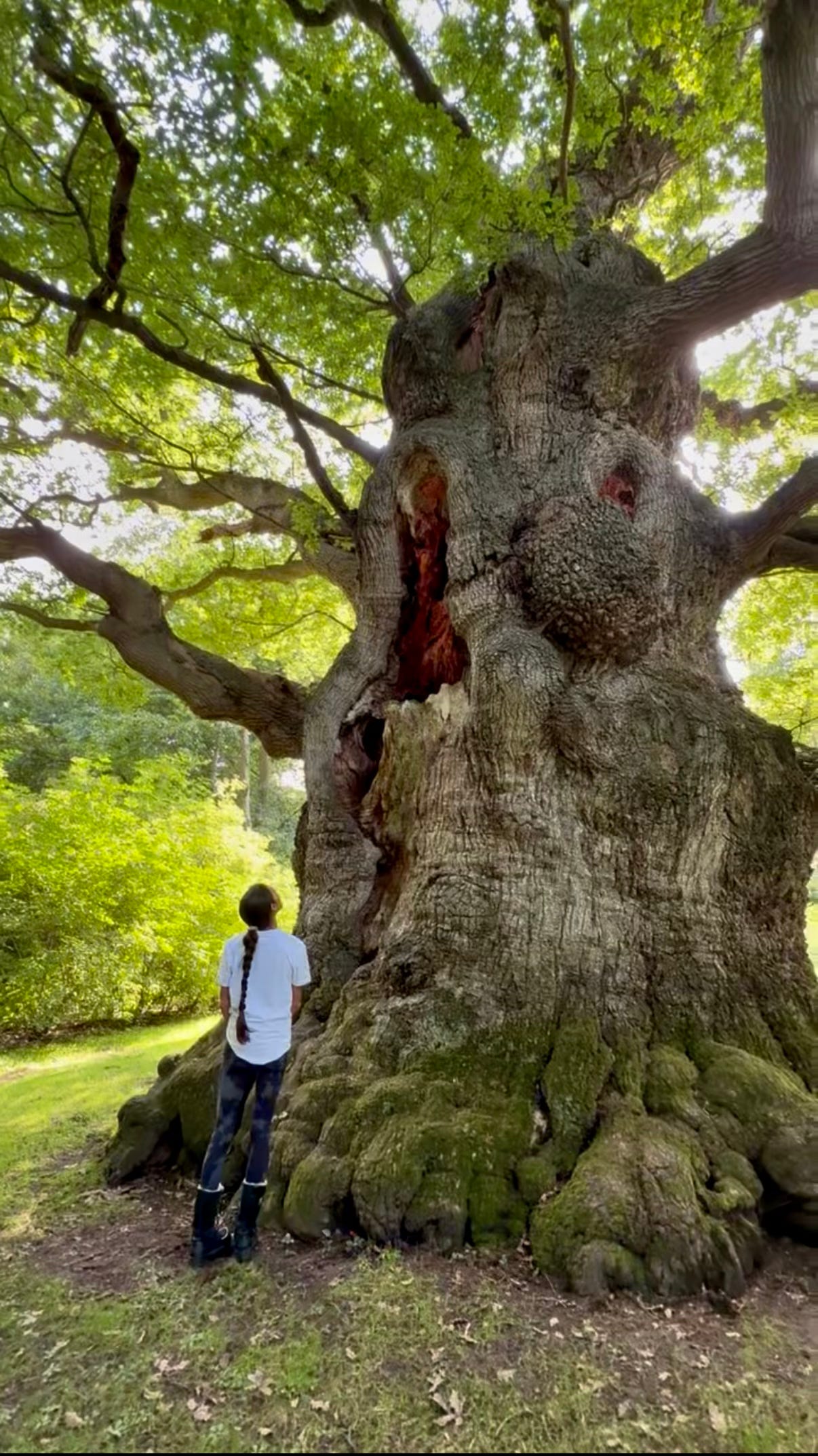
The question above: ‘Are Trees Intelligent’ isn’t one of those impossible-to-answer existential questions, but a very real one—whose answer shifts depending on how we, as humans, choose to see it. I believe the answer matters. When trees are not seen as intelligent, they become easier to dismiss, easier to exploit, and easier to destroy. Forests and complex ecosystems are lost not because they lack worth, but because we fail to recognise it.
Trees are more than the sum of their parts, and far more valuable than the wood (and other resources) they produce. And this is why I keep returning to this question.
As humans, we carry the responsibility of verbal language. What we say—and how we say it—changes meaning. Knowledge and language have the ability to spark curiosity, and when we are curious, we care.
That is my goal: to find a language that bonds humans to trees.
When a general consensus begins to emerge that trees might be intelligent, things change. My industry (arboriculture) in the UK is sadly incredibly unregulated — most tree surgeons love a chainsaw and not a tree. As an indirect result of this, most homeowners are never helped to understand what a tree is, how it lives, or what it needs over time. I’m still amazed at the number of homeowners who see their trees primarily as problems to be fixed — so seeds and leaves aren’t shed over swimming pools, cars and driveways. I would love to find a way of forging a relationship between person and tree across their shared lifespan. I want someone to look at the trees in their garden and love them. Part of that solution lies in knowledge, and part of it lies in language.
So, intelligence is a word for us, rather than trees. They know what they are, and they don’t care. But the word has the capacity to create change in us.
I’m not under any illusion that recognising trees as intelligent will automatically save them. Sadly, history gives us no reason to believe that. We now recognise intelligence in dolphins—and yet we continue to hunt, capture, and confine them. Intelligence, on its own, has never been enough to protect a species from human greed. So perhaps saving trees doesn’t begin with protection at all, but with perception, and maybe the deeper question is whether recognising intelligence changes us.
Dolphins didn’t become less intelligent when we learned to measure it. What changed was our discomfort. Intelligence forced a mirror on our behaviour—and we largely chose to look away. But even so, something changed. New conversations around morality emerged. Captivity began to feel a bit uneasy rather than unquestioned, and a moral friction appeared.
This brings me to ancient trees.
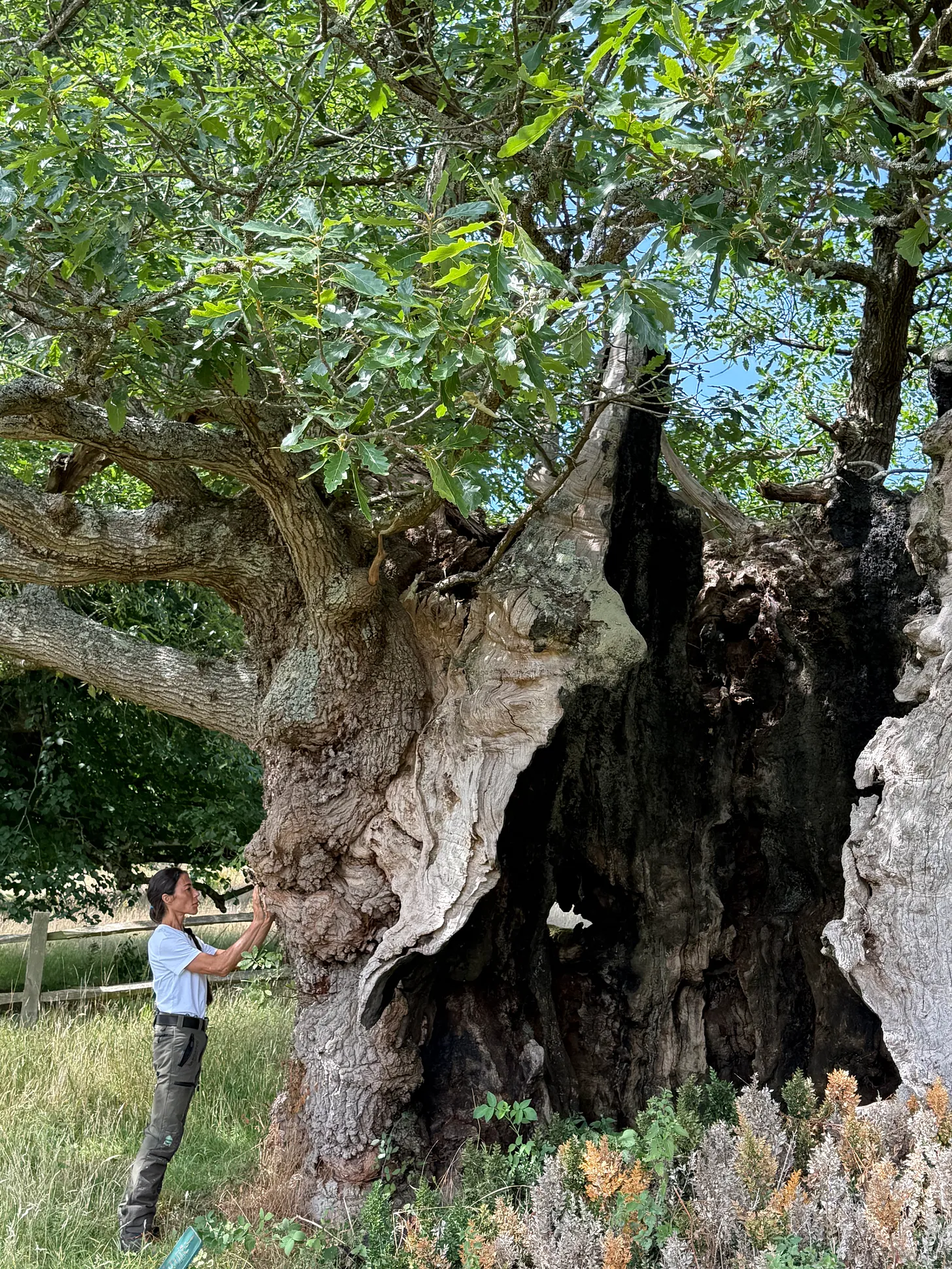
There is a collective, almost unified care for very old trees. Look at the public outrage over the Sycamore Gap tree. People stop when they’re at the foot of an old tree. They gaze and stand in awe. People don’t feel silly calling an old tree wise, sentient or intelligent.
But why is this reverence reserved for only the very old?
Why do we struggle to extend the same care to a beautiful mature tree—or a young one? Why does value seem to accumulate only with extreme age?
I would love to live in a world where young, teenage, mature, and ancient trees are all revered. Perhaps that is where the real work lies.
What if recognising intelligence in trees doesn’t stop destruction overnight—but slowly erodes the certainty with which we justify it? What if it changes the language we use, the ease with which we cut trees for human comfort, the stories we tell ourselves about what is expendable and what is not?
What if the value is not protection, but learning?
Seeing is shaped by who we are
My hope is that one day, within my lifetime, we reach a critical mass where we no longer see trees primarily as objects or resources. This won’t come from a quantum leap in scientific understanding. What will tip the balance is not more data, but a change in how we see.
And that is the irony. We can only ever see trees through our experience of being human.
Many parents think their own offspring is a genius, or special in some wonderful way. I’m testament to that bias from my own parents bless them! I’m not a genius and never was! (My greatest achievement, if I have one, is managing to wake up, go to work, find humour in the day, and stay curious about the world I’m part of).
But that’s my point. If we care about what’s in front of us, we see something different. If we have a rich inner world that tolerates complexity, we tend to see one reflected back at us.
Who we are shifts what trees are.
As the saying goes: we don’t see the world as it is, but as we are.
So let’s return to the original question. Ask anyone who truly appreciates trees whether they think trees are intelligent, and the answer is almost always yes. Often people can’t articulate why —but it feels true. And in this case, that is a good enough place to begin.
Why science struggles with this question
Science hasn’t answered the question of what intelligence is in humans particularly well—so how can we conclude so confidently that trees are not intelligent?
The question of intelligence seems to sit across multiple areas and I increasingly wonder whether it is as much a philosophical question as a scientific one. While I deeply value the scientific method, I don’t love the untouchable doctrine that goes with it.
We treat certain assumptions as immovable truths: that fundamental constants like the gravitational constant are fully settled (despite persistent measurement uncertainty), that all inheritable information resides solely in genes (despite epigenetic inheritance), that nature is fundamentally mechanistic. Rupert Sheldrake talks really thoughtfully about this in The Science Delusion. These began as working hypotheses, not certainties — but many have hardened into belief. Science is not a religion. It is a method for understanding the world we live in. And it falls short when certainty becomes tethered to it.
What trees actually do
Trees have evolved on land for around 385 million years. Their timescales are vast. Their decision-making happens over seasons, decades, even centuries.
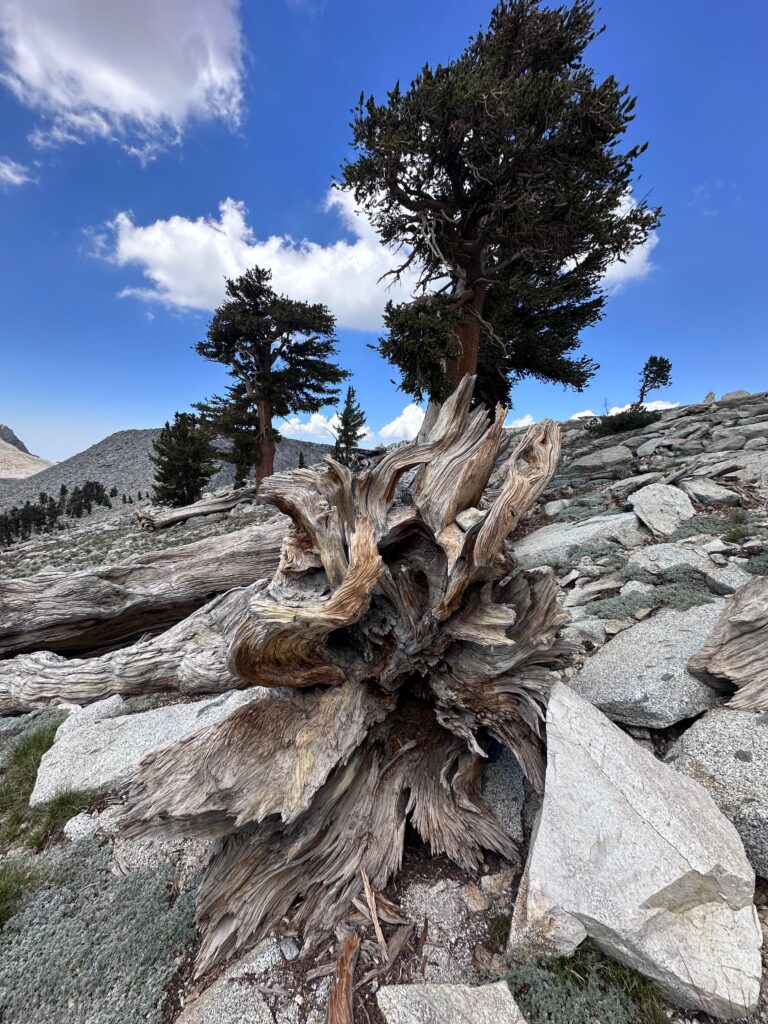
Trees don’t respond to the world randomly or blindly. They retain imprints of past disturbance —events like droughts, fires, insect attacks—not as images stored in a brain, but in wood anatomy, altered growth rates, and long-term changes in how they use water. You just have to look at a tree ring, and it’s all in there.
When attacked by insects, trees release chemical signals into the air and soil. Neighbouring trees that detect these compounds often upregulate their own defences, sometimes before the insect even reaches them. Resources are constantly allocated and reallocated: growth is slowed in one branch to preserve another, or a branch is shed entirely because it biologically costs too much to keep. Summer branch drop where trees shed a limb can be a very normal drought response and is prevalent in species like oak and cedar —but this isn’t a defect demanding removal, it’s just adaptation.
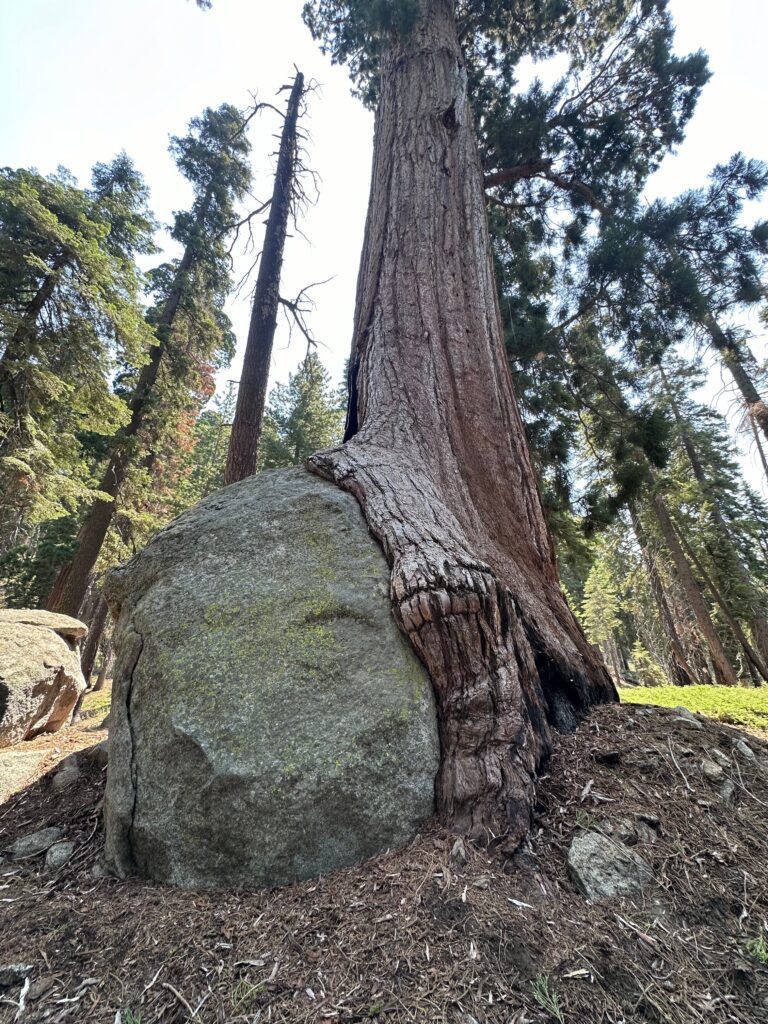
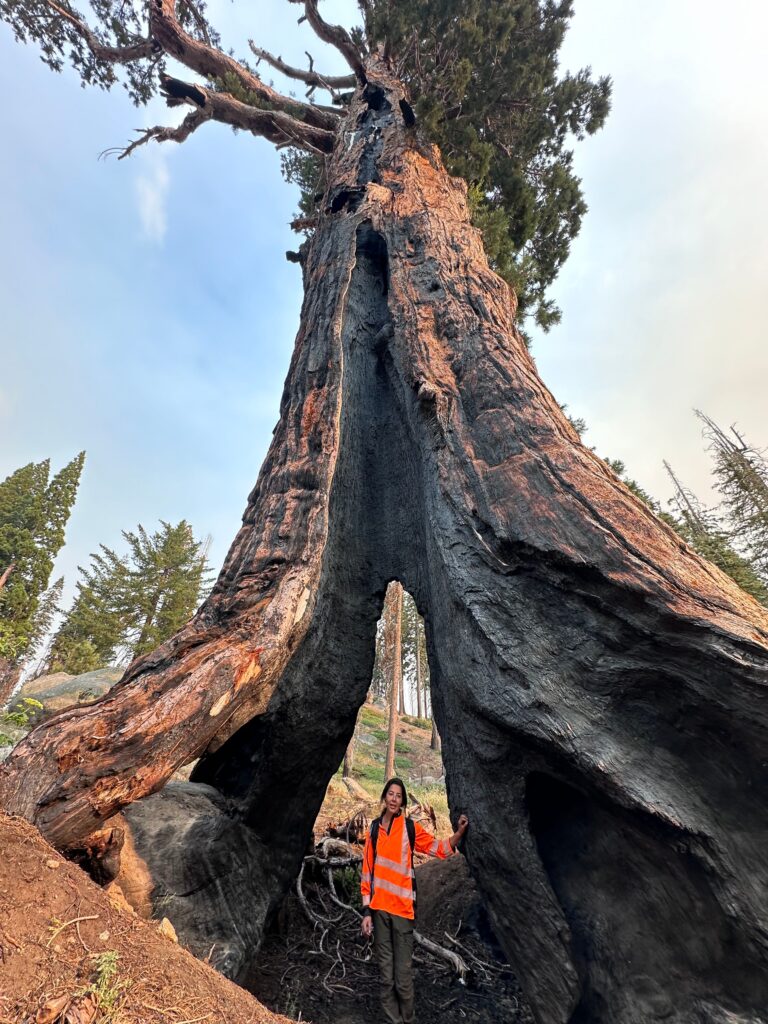
Trees adjust their crowns and root systems in response to neighbours. In giant sequoias, roots can fuse, increasing stability for the wider community. Mycorrhizal fungi extend these relationships further still, moving carbon, water, and nutrients across whole systems.
Old-growth “legacy” trees often act as anchors doing disproportionate ecological work. Unlike our tendency to sideline the elderly and ship our grannies off to old-people’s homes, old trees are not redundant. As trees age or are damaged, they reorganise: redirecting growth, altering architecture or opting for renewal. What we’re seeing isn’t decision-making in the human sense, but constant, real-time relationship with the environment.
If intelligence includes memory, communication, trade-offs, and the ability to adjust behaviour over time, then trees meet those criteria—just on timescales we are not used to recognising. They remember without neurons. They learn without a hippocampus. They do all of this without a brain—and they do it really really well.
Our discomfort with slowness
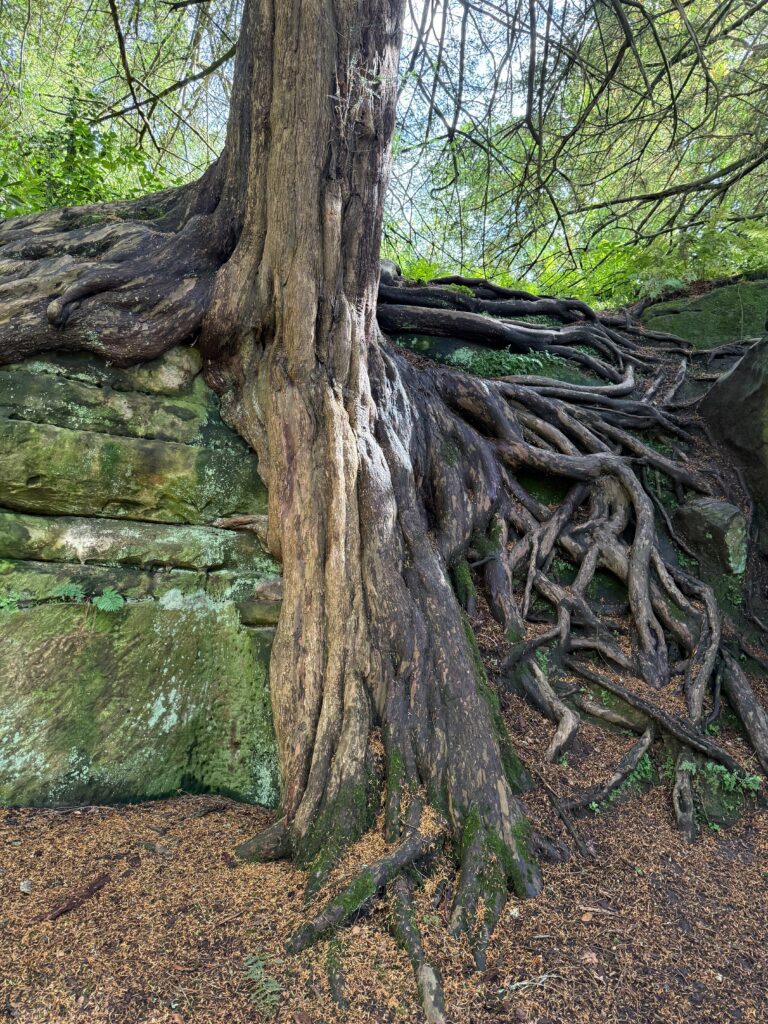
Perhaps part of our resistance to calling trees intelligent is a discomfort with slowness. Or perhaps we simply got it wrong—and we are the ones who fell short.
Humans have consciousness and language, yet look where that has taken us: war, greed, destruction, fragmentation, competition, our ability to destroy the very resources we depend upon. We are the only species with complex verbal language—and yet we struggle profoundly to communicate what actually matters.
We rely on categories and labels to make sense of the world. When something doesn’t fit our language, we rarely question the language. We question the thing.
We associate intelligence with speed: fast reactions, rapid problem-solving, quick decisions. Trees operate on an entirely different rhythm. But slowness is not the absence of intelligence.
Humans have been human for a fraction of Earth’s history. We evolved to move quickly and to track quickly. It is an entirely different system. And yet we have made our form of intelligence the benchmark against which all others are measured. I feel like there is something quite inherently wrong with that.
The ethical edge
Intelligence, as we currently define it, is comically narrow-minded. It prioritises brains, speed, individuality, IQ, economic earnings, innovation, creating just for the sake of creating, and abstract problem-solving. Trees don’t conform to that model—so we hesitate.
Yet our science still can’t fully explain consciousness, intelligence, or even the brain itself. Wouldn’t the most scientific approach be humility, uncertainty, and curiosity?
Could there be different kinds of intelligence—distributed rather than centralised, emerging through relationship, time, and place? Intelligence we haven’t learned to see because it doesn’t look like us?
There is an ethical edge to this question whether we acknowledge it or not. If intelligence only counts when it mirrors our own—fast, vocal, individual—what does that justify? What does it make permissible?
Something feels profoundly wrong. Our communities are fragmented. Beautiful trees are pruned far too enthusiastically without thought or removed with alarming ease. I witness this daily driving through the green lanes of Surrey. The living world is reduced to productivity and utility, coerced into forms that don’t shed leaves on the patio. It’s absurd. We ask garden trees not to be trees for our comfort. Somewhere along the way, our constructs stopped serving life well. I’m not trying to be right. I’m interested in asking better questions. Questions that slow us down. Questions that invite us to look again—at trees, and at ourselves.
Tags: